Easter in the Whirlwind
How spring, suffering, and the mystery of resurrection reveal a life greater than death

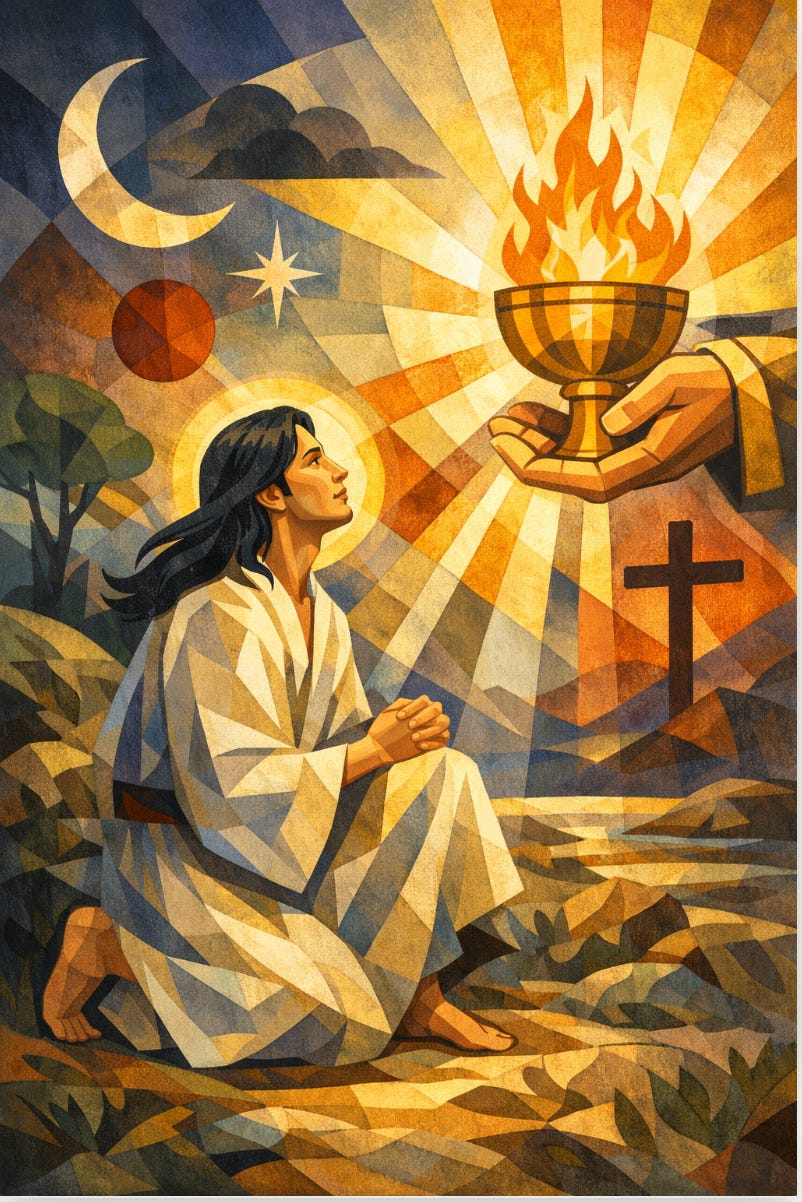
There is a power in life that does not ask permission. It does not stop to explain itself. It does not consult our preferences, our fears, or our little plans for safety. It pours through the world like fire through a wire, like current through a filament, like a blowtorch laid against iron until the metal glows, softens, and begins to lose the shape it once defended. The same force that makes the thing shine also begins to melt it. The same energy that animates form also consumes it.
We know this feeling. We may not always have words for it, but we know it. We feel it in the first warm days after winter, when the frozen earth loosens and the hidden things begin to stir. We feel it in the sun itself, that great indifferent furnace hanging over all our hopes and dramas, calling seeds out of the ground, drawing sap through the tree, pulling weather across the sky, lifting mist from the sea, driving the ocean currents, bleaching bone, cracking stone, and grinding mountains patiently into sand. There is grandeur in it. There is beauty in it. There is no sentimentality in it at all.
That is one reason spring moves us the way it does. It is not merely pretty. It is violent with renewal. It does not politely decorate the dead world. It overwhelms it. It enters the frozen field and says, in effect, Move. Rise. Break open. Begin again. The bud does not emerge by remaining intact. The seed does not become a flower by preserving its seedness. Life advances by expenditure. It spends itself. It presses outward. It breaks the shell, cracks the husk, splits the bark, burns the fuel. Every blossoming carries within it the inevitability of its passing. Every flower is here for a season, and that season is holy precisely because it does not last.
At a certain point in life, if we are paying attention, we stop asking merely to be comforted by this world and begin trying to understand what sort of world this actually is. We notice that the same sun that nourishes the wheat also scorches the field. The same sea that carries the ship also swallows it. The same passion that makes us vivid and brave can also drive us to folly, exhaustion, and grief. The same body that once leapt, desired, built, and conquered begins, slowly and without apology, to bend, fail, and return to the elements from which it came. The force is wonderful. The force is terrible. It gives hope to the timid because it proves that nothing stays buried forever. It strips the proud because it shows them that their strength was never their own.
This is where the soul begins to mature. Not when it learns a few religious ideas. Not when it adopts the right language. Not when it becomes more optimistic. It matures when it can stand, even briefly, in the presence of this enormous fact and not look away. Life is bigger than our self-concern. Bigger than our panic. Bigger than our plans for self-preservation. Bigger than our attempts to freeze the moment and call that safety. We are not living in a padded nursery. We are living inside a blazing process.
That is one reason the Book of Job remains so powerful. Job does not complain because he is shallow. He complains because he is sincere. He has been torn open by existence. He has suffered losses so immense that the ordinary religious answers sound insulting. He wants God to explain Himself. He wants the terms of the arrangement made clear. He wants a moral diagram small enough for the human mind to hold. Many of us, if we are honest, want the same thing. We want a universe that feels answerable to our scale. We want to know why the innocent suffer, why the strong collapse, why the faithful are sometimes broken, why death cuts across love as if love had made no claim at all.
Then comes the reply from the whirlwind.
It is one of the most frightening and liberating moments in all sacred literature. God does not explain the machinery of Job’s suffering. He expands the field. He overwhelms Job’s question, not by dismissing it, but by placing it inside a reality so vast that the question itself is changed. Where were you when the foundations of the earth were laid? Have you commanded the morning? Can you bind the sweet influences of the Pleiades? Can you draw out Leviathan with a hook?
This is not cruelty. It is scale. It is the shattering of spiritual provincialism. Job is being brought to the edge of a realization so great that the survival mind begins to lose its throne. Not because suffering does not matter. It matters very much. Not because pain is unreal. It is terribly real. The change happens because Job begins to see that life is not a little household arranged around his personal continuance. It is immeasurable. It is wild. It contains forces that do not fit into the narrow courtroom of human grievance. It includes the mountain goat, the storm, the deep, the stars, Behemoth, Leviathan. It includes the things we call beautiful and the things we call monstrous. It includes birth and dissolution in one indivisible power.
And Job’s answer is not really an answer. It is a seeing. He puts his hand over his mouth. He repents in dust and ashes, not because he has been humiliated into submission, but because he has seen too much to continue talking as though life were a small thing. The soul that has glimpsed the scale of reality no longer clings to its own survival with the same desperation. Our panic begins to look provincial. Our instinct to protest every change, every loss, every ending as though the cosmos had violated a private contract begins to weaken. Something greater enters. Awe. Fear, yes. Trembling, yes. But also awe.
This is where Easter begins to reveal its metaphysical depth. Most people approach Easter through consolation alone, and I understand why. We want reassurance. We want tenderness. We want to hear that death is not the end and love survives the grave. All of that matters. All of it belongs. But Easter enters more deeply when we have first stood where Job stood, under the whirlwind, with the scales torn from our pious, religious sentiments.
Jesus does not go to the cross as though he were clinging to earthly continuity at all costs. Again and again he points beyond this world without despising it. He points toward heaven, toward the Father, toward the enduring reality behind the visible one. He heals bodies, blesses children, feeds the hungry, weeps with the grieving, and still never lets the soul imagine that this present vehicle is the whole of life. He speaks of laying up treasure in heaven. He says not to fear those who kill the body but cannot kill the soul. He speaks of many mansions. He tells the thief beside him, Today you will be with me in paradise. He lives as one whose center of gravity is already anchored in another country.
That is what gives his passion its particular kind of majesty. He suffers fully. He does not drift above it in pious abstraction. He feels abandonment, thirst, agony, betrayal, public humiliation, bodily torment. He enters the worst of it. Yet even there his orientation does not collapse inward upon self-preservation. His eyes remain turned toward the larger life. Toward the unchanging land. Toward the kingdom that is not built of flesh alone and therefore cannot be finally destroyed by the breaking of flesh.
This is not indifference in the cheap sense. It is not emotional numbness. It is spiritual scale. It is the knowing that when one form is spent, life is not spent. When one vessel breaks, being itself is not broken. When one garment is worn out, the soul is not thereby annihilated. It passes. It is raised. It is refined. The old religious languages vary here, and people will describe the mystery differently. Resurrection. New body. Spiritual body. Return. Translation. Continuance. Further life. I would leave some room around the edges of all these words. The point is not to force a diagram where revelation has left us symbols. The point is to see what Jesus kept seeing: death is real, but it is not final. It is a threshold event in a life too large to be contained in one season of embodiment.
Perhaps that is why the image of a rocket feels so right. A rocket does not preserve itself. It spends itself in flame. The very fire that destroys its lower stages is what lifts its payload beyond the grasp of gravity. Something burns out. Something falls away. Something reaches orbit. There is loss in the process, real loss. Noise, violence, heat, expenditure. Yet the purpose was never the perpetual survival of the booster. The purpose was ascent. In that way, an individual lifetime, through its trials and victories, through its griefs and fidelities, through its humiliations, disciplines, loves, and acts of courage, may be understood as lifting the soul closer to the divine life. Perhaps closer enough to dwell there more fully. Perhaps closer enough to return with greater strength and greater wisdom. The old traditions preserve hints of both.
This is where the darker names begin to make sense. Kali. Mara. Leviathan. Not merely as horrors to be rejected, but as names for the tremendous side of reality that breaks forms, devours illusions, mocks vanity, and forces the soul to confront what it cannot control. Every serious spiritual tradition knows this face. There is a devouring aspect to truth. There is a deathly aspect to transformation. The ego experiences it as catastrophe because the ego was built to maintain continuity, status, and self-reference. The soul experiences it differently. Not always pleasantly. Not always with immediate understanding. Still, at depth, the soul begins to recognize in these terrible powers not mere malice but magnitude. Not personal hatred but the fierce refusal of life to remain imprisoned in smaller forms.
And yet the story does not end there. It never ends there. The same sun that erodes the mountain also fills the cold morning with gold. The same current that can melt the wire also fills the city with light. The same spring thaw that turns hard ground into mud also makes possible the green fuse of the flower. The world is not safe in the sentimental sense. It is fertile. It is not tailored to our comfort. It is charged with becoming.
That is why Easter belongs so naturally beside the spring equinox. Light increases. What was hidden begins to announce itself. The tomb and the garden draw near to one another. The stone is rolled back. The air is still cold. The scars have not disappeared. The body that rises is not merely a return to yesterday. It bears continuity, and it bears transformation. That matters. Resurrection is not simple reversal. It is passage. It is the mystery that life, after being pressed through limitation, emerges in another order.
Job sees that life is vast. Jesus shows that it is trustworthy.
Not easy. Not soft. Not arranged according to our immediate understanding. Trustworthy.
That is the ray of hope, and it is more than a ray. It is enough to live by. The flower does not bloom because it has been guaranteed permanence. It blooms because life is moving through it now. The soul does not endure because it has mastered the mechanics of its fate. It endures because it belongs to something greater than fate. The body has its season. The personality has its weather. Civilizations rise and fall. Love ripens and breaks our hearts and changes us forever. The earth itself is under long processes of fire, pressure, and dissolution. Still, none of that proves meaninglessness. It may reveal a scale of meaning larger than our desire for comfort can comprehend.
So as Easter approaches, I would not ask the soul merely to feel consoled. I would ask it to feel enlarged. To stand for a moment in the blast furnace of reality and notice that what is melted away is not always the most precious thing. Pride goes. Pretension goes. The fantasy of control goes. The frightened insistence that this one visible form is all there is begins to weaken. Something quieter appears. Something braver. A willingness to live this season fully, to suffer it honestly, to love within it deeply, and to let it lift what it can lift toward heaven.
We are here for a season. That is not a small thing. It is a sacred thing. Like flowers. Like flames. Like launch vehicles. Like the Son of God moving through the cruelty of this world with healing in his wings and another country already alive within him.
The land changes. The forms pass. Winter loosens its grip. The soul keeps going. And somewhere beyond our fear, perhaps even within it, life is already preparing its next incarnation.