The Truth the Ego Cannot Bear
Why we soften reality, reject intuition, and call the world an illusion

People say the world is an illusion as though that settles something.
At its best, the phrase points to a real spiritual insight: appearances shift, the senses mislead, and the personality mistakes passing drama for ultimate truth. But in common use, it often does something simpler. It softens the blow. It turns existence into a concept just when existence gets too sharp to face directly.
Cassandra and the problem of early truth
This makes me want to read between the lines in the myth of Cassandra.
She’s the woman who refused Apollo’s advances. So he cursed her by enabling her to see the future but making it so no one would believe her. True, but not deep enough. Archetypally, she represents the part of the soul that sees before the ego is ready to admit what it sees. She’s not just prophecy. She’s the unwelcome perception. She’s intuition arriving too early, too clearly, and too painfully for the conscious mind to accept.
The intuition sees consequence while the surface mind is still negotiating appearances. It senses where things are going before the ego has the courage to name it. In that sense, Cassandra is not only a figure from myth; she’s a recurring human experience. Everyone has felt, at least once, that inward recognition of something true before they had the language, strength, or permission to accept it.
If the gods symbolize powers within the mind, Apollo can be read as the bright ordering force of consciousness: clarity, form, legitimacy, explanation. Cassandra stands for a deeper perception, the layer that registers truth before the ego can organize it. The myth becomes a drama between intuition and self-protection. The soul sees. The surface mind resists. And what it cannot refute, it discredits.
Beauty, severity, and spiritual avoidance
That conflict is not ancient history; it’s daily life. Because reality is not only beautiful; it’s beautiful and terrible.
This is the part most people don’t want to admit. They want the sacred without the severity. They want an easy transcendence. They want a God they can adore without having to reckon with the brutality woven into life itself.
The lamb is holy. The lion is noble. But the lion eating the lamb is somehow a scandal.
This is where cheap spirituality starts to sidestep reality.
It doesn’t do it maliciously. It’s just being defensive. It keeps the light and edits out the teeth. It talks about illusion not to see more clearly, but to avoid contact with what is hard, humiliating, or unbearable. It uses metaphysics as anesthesia.
And then, almost predictably, it demonizes the ego.
But the ego isn’t just vanity. It’s also structure. It’s the provisional self that helps a human being endure contact with a reality too vast, too contradictory, and too severe to absorb all at once. It can become arrogant, manipulative, and false. Of course. But before it becomes a tyrant, it begins as a buffer.
This matters.
Because the soul knows the truth long before the ego can bear it.
This one fact explains more than we want to admit. It explains why people feel something is true, then flee it. Why they admire honesty in principle but punish it in practice. Why conscience speaks and the ego immediately begins negotiating. Why flattering narratives survive long after reality has exposed them.
Refusal, distortion, and the birth of inner evil
It even helps explain part of what we call evil.
Not evil in the cartoon sense. Something more ordinary and more dangerous: refusal. Refusal to see. Refusal to let reality disturb a false sense of self. Refusal to accept that existence includes not only tenderness, meaning, and order, but also predation, loss, destruction, and terror.
A person cannot keep refusing truth without becoming distorted by that refusal.
This distortion can turn sentimental. It can turn ideological. It can turn violent. But the root is often the same. Reality presses inward, and the ego cannot bear it. So it edits what it sees.
This is one reason the phrase “the world is an illusion” so often rings hollow. People say it while panicking over status, loss, sickness, betrayal, aging, death. They say it while clinging to every passing form. This doesn’t mean that all form is ultimate. It means the slogan doesn’t quite fit the reality.
Yes, there is illusion in human life. Projection is illusion. Vanity is illusion. False identity is illusion. The stories we tell ourselves to avoid responsibility are illusion. But suffering is not an illusion in any cheap sense. Nor is mortality, the cost of embodiment, or the collision between beauty and violence.
The human problem isn’t that we take the world too seriously; it’s that we want to take only the pleasing parts seriously.
Job, Leviathan, and the scale of reality
This is why another famous text, the Book of Job, matters.
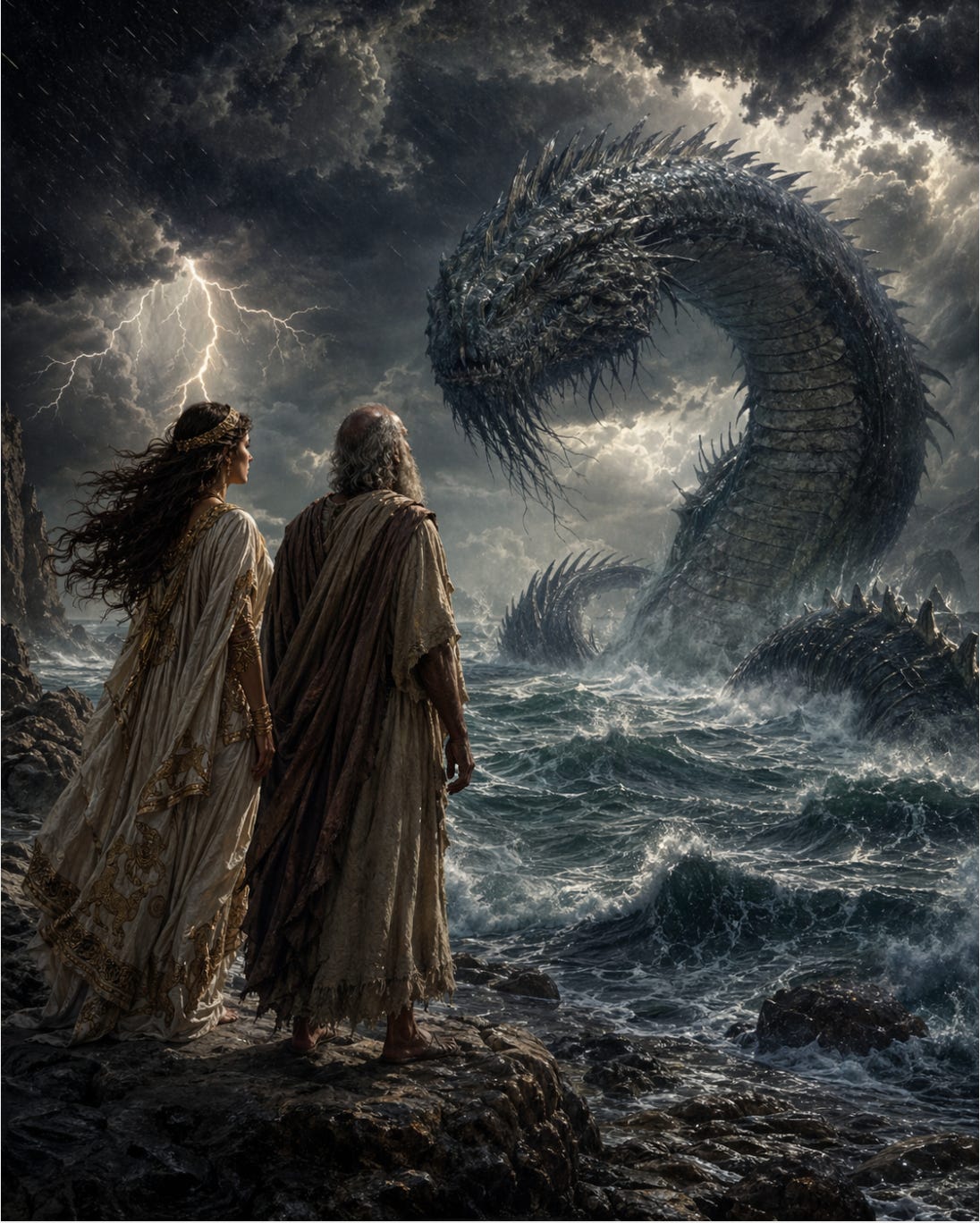
God doesn’t give Job an explanation that makes his suffering feel reasonable. Instead, he brings him to the edge of an enormous scale. He confronts him with a reality too large for his categories. And there, among the great symbols of that confrontation, stands the sea monster, Leviathan.
Leviathan scares the ego because it refuses domestication. It doesn’t fit the devotional preference for a universe trimmed to human emotional proportions. It’s part of creation, and this is precisely the problem. Job isn’t comforted by being told that reality is less terrible than it seems. He’s shattered by the discovery that reality is greater than his mind can comprehend.
This is one of the Bible’s hardest lessons. God doesn’t answer Job by making existence smaller. He answers by showing Job just how small he is in relation to it.
This is why people can speak of loving God while quietly resisting reality. They love a selective God. A curated God. A God of reassurance, uplift, and inner warmth. But the God whose creation includes abyss, appetite, storm, extinction, and untamable force is harder to praise sincerely. Harder even to look at.
Yet that may be where religion becomes real. Not when it consoles but when it enlarges our capacity to embody what’s real.
Can you remain in contact with truth when truth stops flattering you? Can you stand before existence without demanding that it match your moral sensibilities before you call it divine?
This is a more serious test of spiritual maturity than most modern conversations about spirituality allow.
The beauty and the horror
Some movies have touched this nerve because art can sometimes say what spiritual language keeps diluting. At the end of Apocalypse Now, Kurtz says, “The horror.” The line hits hard because it’s not commentary. It’s recognition. A veil drops. What remains is contact with something raw and undeniable in man and in existence. In Dune, after drinking the Water of Life, Jessica says, “The beauty and the horror!” The force of the line is that she doesn’t separate them. She names a single revelation. Reality at depth isn’t divided into what pleases us and what offends us. It arrives whole.
That is what weaker spirituality cannot tolerate. It wants beauty without horror, spirit without blood, illumination without the cost of seeing. But vision does not work that way. The deeper you see, the less sentimental the world becomes. Not because meaning disappears, but because meaning expands beyond comfort. Reality grows larger, not gentler.
The veil of necessity
Others have sensed this in their own way. Simone Weil suggested that necessity itself is God’s veil, that space, time, and matter stand between us and direct divine radiance so that we can endure existence at all. Aldous Huxley argued that the mind survives by filtering reality through a reducing valve, allowing only a narrow stream of what is there to reach awareness. Both point toward the same possibility: reality comes to us filtered because unshielded exposure would be too much.
Weil saw something severe and useful here. When she says necessity is God’s veil, she means that the fixed conditions of existence—time, matter, causality, limitation, suffering—do not merely hide God. They also protect us. They create the distance that allows creaturely life to exist at all. In her view, space, time, and matter stand between us and direct divine radiance because unmediated exposure would overwhelm us. That does not make the world unreal. It makes the world mercifully mediated. The veil is painful, but it is also what allows us to endure, to choose, and to seek.
Incarnation as mercy
There is an old spiritual idea that souls line up to incarnate because physical life offers growth. Perhaps. But what if that is only half the truth? What if souls also line up because density is merciful? What if embodiment, for all its pain, is still a buffer against more immediate contact with reality in its full intensity?
Matter slows things down. It breaks the whole into sequence. It gives the soul a body, a story, a horizon, and therefore a kind of shelter. Physical life may be harsh by human standards, yet still gentler than unshielded exposure to truth without form. In that sense, incarnation would not be only a school. It would also be a veil.
We may not cling to form only because we are deluded. We may cling to it because form protects us. The finite is painful. But the infinite, encountered too directly, may be more than most souls can bear. The body, then, would not be merely a prison. It would be a mercy.
Back to Cassandra
This brings us back to Cassandra, but at a deeper level.
She stands for a law of consciousness: truth often arrives before the self has developed the capacity to receive it. The soul sees. The ego stalls. The personality bargains. What could have become transformation becomes rejection.
That is why the ego so often rejects intuition. Not because intuition is always wrong, but because intuition is often early. It arrives before the personality has found language, courage, or surrender. It tells the truth before the self has negotiated its terms.
And when that happens, the usual response is not reverence.
It is dismissal.
The warning is called dark. The insight is called unbalanced. The seer is called unstable. The message is condemned not because it lacks force, but because it’s too much.
This is a frightening thought. It means human beings often reject truth not when it is weakest, but when it is strongest. Not strongest rhetorically. Strongest existentially. Strong enough to rearrange everything we know.
Resistance with incense on it
This is where the ego becomes dangerous. Not in merely existing, but in absolutizing itself. In deciding that whatever exceeds its comfort threshold must be denied, sentimentalized, or attacked. That is how inner evasion becomes moral corruption. A person unable to bear truth begins to punish whatever reminds him of it.
He edits reality, then calls the edit wisdom. He softens severity, then calls it compassion. He hides behind spiritual language, then calls it transcendence. That is not awakening. That is resistance with incense on it.
Real awakening is harsher at first. It doesn’t immediately soothe. It strips. It reveals how much of one’s moral posture, religious language, and emotional certainty was built to avoid direct contact with life as it is. It shows that the universe is more beautiful than the ego knew, and more terrible than it wanted to know.
The beauty and the horror—together, always together.
The real threshold
That does not mean we should collapse into nihilism. It means we should stop calling honesty pessimism just because honesty wounds our preferences. It means we should stop using “illusion” as a charm against seriousness. It means we should stop treating the ego as a villain when, in many cases, it is simply overwhelmed.
The task is not to hate the ego. The task is to outgrow its limits without lying about why those limits exist. And the task is not to escape the world by declaring it unreal. It is to see more deeply into what is real within it.
Maybe this is why revelation feels dangerous. Not because truth is evil, but because truth is too whole for the self that wants only selected parts of God. We say we want reality. Usually we want a usable version. We say we want awakening. Usually we want relief without disillusionment. We say we want God. Usually we want beauty without Leviathan.
But the soul does not grow by being protected from severity. It grows by becoming capable of remaining open in its presence. That is the real threshold. Not whether you can speak spiritual language. Whether you can love truth before it has been made pleasant.
That’s where religion stops being decorative.
That’s where the soul becomes credible to itself.